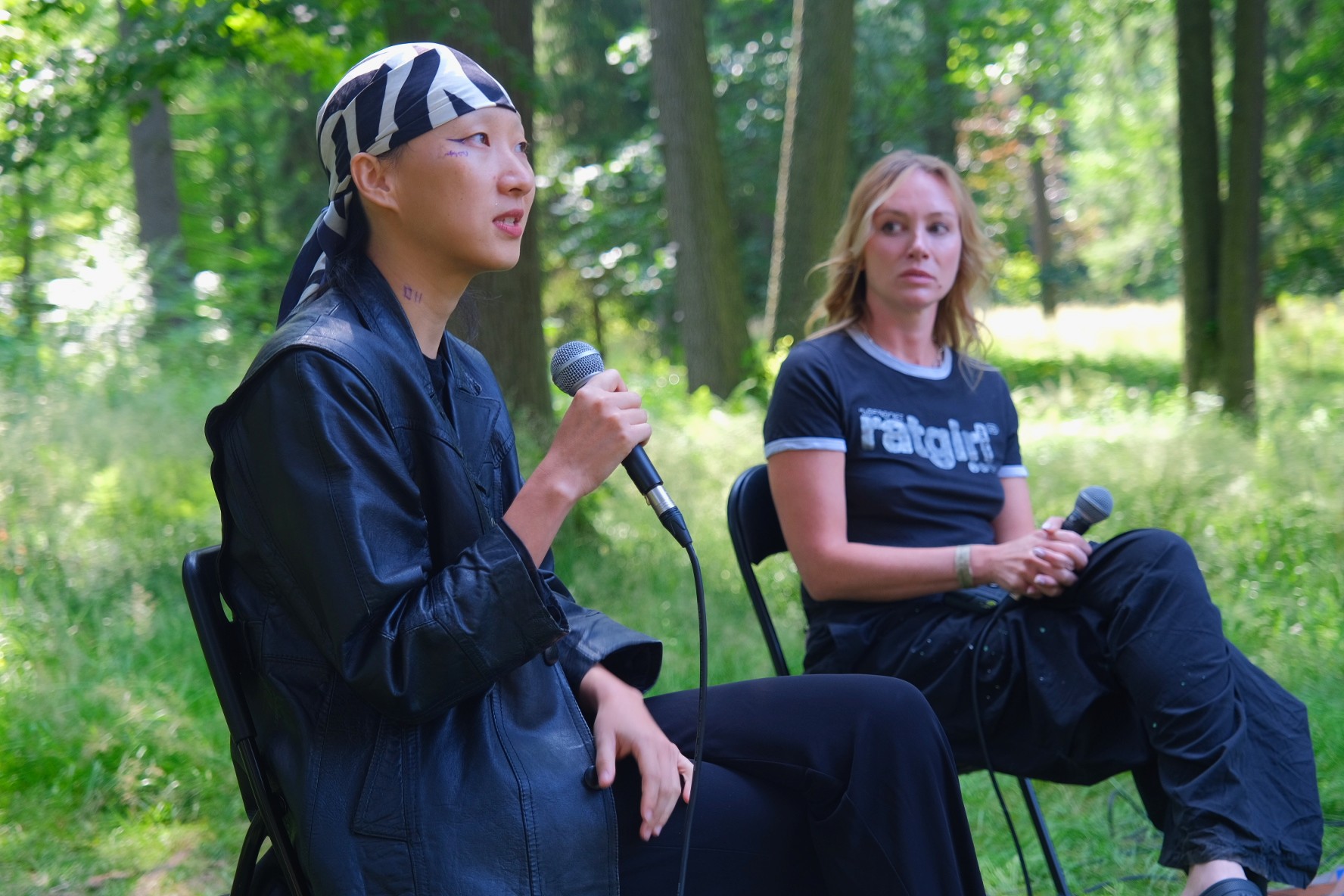
O żałobie dźwiękowej i cybernetyce egzystencjalnej Rozmowa Dana Su (su dance110) z Natalią Sielewicz
N: Thank you, Robert. I will switch immediately to English to avoid any confusion, but
I’m thrilled to be here and to share this grass stage with Dan Su aka su dance110. As
Robert mentioned, we witnessed their incredible, monumental performance two nights
ago, but also in Warsaw, we had the chance to experience it in a very different setting—in
an institution, in a concrete building at MSN—which foreshadowed the festival themes that Robert and Amelia expanded upon in yesterday’s panel. I think these themes are strongly felt in our bodies as we witness the generosity and depth of the performance.
Dan Su is an incredible polymath. Their majestic forms on stage are informed by multi-
layered, deconstructed sounds and genres of music. As you probably noticed from the
first moments, the gestures and body movements stem not only from choreography and
their background in dance but also from machine learning, and their background in
statistics. This may sound surprising, but I feel we’ll explore these themes today. I am
still deeply moved by the performance, even though my body has become a vessel for
the further performative acts we witnessed.
Today, we’ll talk not only about the formal and processional aspects of such a
monumental performance but also about the affective and spiritual dimensions,
particularly Sonic grief, which threads through Dan Su’s work. You are also a poet and
writer, so I’d like to touch on that. But first, it would be amazing if you could introduce
your artistic journey and how you arrived at what we saw on stage two nights ago —especially how the body, gestures, sounds, complex sonic forms, and voice all
converge. Voice, in particular, is closely linked to identity and is one of the most singular
aspects of our personhood. Could you offer us a retrospective of your journey as an
artist?
S: Yes, it’s been quite a path. I started performing as a kid, but then I went into academic, studying quantitative methods at the University of Wisconsin, Madison. Simultaneously, I was dancing and pursuing artistic practice. Later, I moved to Berlin and completed a Master’s in choreography at UdK and Hochschule für Schauspielkunst Ernst Busch.
During that time, the sonic aspect of my work emerged. I was seeking specific sounds.
Then I started creating soundtracks for my own performances, and from there, I fully
embraced sound.
Before addressing voice, I might start with gesture first. Because it touches several dimensions of my practice. Firstly, it is the action of writing. Writing itself is very physical
and materialistic for me. I work on paper, textile, and even metal—metal produces
interesting sounds. I’ve done durational large-scale calligraphy performances, as a form of embodied automatic writing. The practice of writing always touches the material dimension.
Another aspect is the translation of analog signals into digital systems. In my earlier work, for example, I created an interactive game performance in which the audience could participate via a tablet interface, using their gestures as input to trigger the sound system. Lately, I expanded my own somatic practice by using movement sensors, exploring how digital technology can transform analog signals into a more extended somatic state.
Then, it is the spatial dimension: placing gestures into specific sites requires awareness
of uncertainty. Learning from the uncertainty of the site informs how gestures, almost like an intent or an initiation, can transform across different dimensions — analog, digital, and spatial.
N: I wanted to touch upon the three thresholds you described—analog, digital, and
spatial—which I find fascinating. They unpack binaries that we often associate with
digital and analog, yet they sync in your work. This is connected to what you describe
as a form of automatic or unconscious writing, where the material resistance of
interfaces—metal, paper, or space itself—interacts with the body. You also mentioned
learning from uncertainty, which resonates with the statistical and Bayesian methods in
your work. Can you talk about that, particularly how it frames performativity and
recursive learning?
S: Bayesian philosophy has existed for centuries. Bayesian inference, I see it as a way
to infer the future outcomes based on past knowledge and present data. It’s about
updating beliefs: what we know from yesterday forms a prior distribution, and today we
gather data to update that belief, inferring possibilities for tomorrow, when dealing with
uncertainty. There is no single truth, only continuously recursive learning.
N: That’s a beautiful way to frame existential cybernetics. It makes us to question past,
present, and future because time isn’t linear—it’s circular. Yesterday is already in the
past, and we continuously acquire knowledge, self-actualizing through recursive
processes. This brings me to grief, an essential part of your practice. Grief is lingering
and non-linear; it can loop in time. I’m particularly interested in queer grief, but also in
witnessing collective grief in contexts of ongoing violence. How does grief feature in
your work? Why the term Sonic Mourning, and how does it relate to time, especially in
performance?
S: My focus on grief traces back five or six years ago, starting with inquiries into
structural violence. My first work on this theme, Dark Twisted Mind, also mentioned
earlier, invited audiences to participate with gestures, investigating compliance within
invisible systems of structural violence. From there, my work evolved through the operatic performance Gentle Brutality, which combined metal-machine structures, movement, and sound, then toward a more internal inquiry with my own voice, culminating in my solo record Shang Can, and further work that I am developing now. It’s a necessary journey for myself to understand the process of grief.
N: Do you think accessing universal grief requires engaging with personal grief? One
cannot fully separate structural and personal violence, but navigating personal grief
allows us to connect more deeply with collective experiences.
S: Precisely. The power of grief lies in its collectivity. Recursive knowledge and
embodied practice intertwine here: an individual body is a site of knowledge, and
collectively, we create space for different realities to coexist and possibilities to
transform together. Grief slows us down, allowing attention to what is disappearing, and
a space where meaning collapses, old models fail, and new forms emerge. Facing this
failure together can be beautiful and even sacred.
N: Your performance really plays with this. Voice is central—it emerges from the body
and is linked to identity—yet your body is expanded through sensors and objects. You
also wear a mask, which conceals identity but makes a powerful statement. Could you
discuss maneuvering between opacity and visibility and how that connects to the body
as a site of knowledge?
S: I resist the perception of a single identity; we all hold plural, layered identities. By
concealing, the mask opens space for the audience’s own imaginations, transcending
fixed roles. And what I am singing is my fantasy language. It is beyond literal meanings.
The mask actually also helps me focus internally during performance, allowing me to
follow my evolving states. I would call the performance an embodied epistemic practice.
I am observing and learning while I am performing. Because there was no set score to
follow. I know where I begin. Everything that follows comes from within. It’s all about the thresholds between the states, and the movement that crosses these different
intensities and emotional densities. It isn’t linear from one A to B. It’s like updating
breaths.
N: Your performance embodies a very sophisticated structure—beyond intensity, there’s
a specific architecture emerging from your self-learning, psychosomatic practice. Could
you talk about the sonic aspect—how your body engages with sound, almost like a
breathing practice? Also, grief is often framed as somber or melancholic, yet your work
carries a powerful energy, which some might call rage. How does this affective force
relate to the sound itself?
S: I work with grief, yet I am more interested in what holds it than in the emotions
typically expressed around it. Through an internal, systematic approach, I explore the
spaces that can be opened for holding, observing, and facilitating the emergence and
transformation of these emotions. From there, I simply stay fully present and watch
whatever arises. The sonic form emerges in the moment within these embodied space. I
work with defined sonic palette and voice elements. It unfolds following my internal
somatic time that connects to this space.
N: How do you arrive at the sonic palette from your interest in the choreography, but
also writing, and why this certain sonic palette became the embodiment for you?
S: The sonic palette grew out of long-term work with electronic texture, noise, and
electroacoustic sound, developed through embodied engagement with metal materials
and objects. It is also informed by the exploration of memory and traditional music.
Grief cannot exist without memory. Yet, it often fails to narrate itself in an unbroken arc.
I would like to have memory reconstructed itself organically. I let silence, abruptions,
and ruptures carry as much weight as sustained flow. It is the process of mourning. In
my palette I also incorporated samples of traditional music from Yunnan, China.
Listening to these pieces evokes tears for reasons I cannot fully explain. It is like having
a dialogue with an ancestral spirit.
N: Do you feel our bodies carry intergenerational memory, responding to ancestral
music? How does technology mediate this, reconnecting us to cosmology and
collapsing the binaries between ritual and synthetic, spiritual and technological?
S: The body carries its own wisdom across the constraints of time. Technology, is a
choice, and its connection to the body raises an ethical question: how do we engage
with the technological advancements available to us, including AI, without losing
ourselves? I want to expand my somatic state through technology, to reflect on myself
and return to my body—on what my body remembers, how it activates its own agency,
and how it carries forward, without shrinking to the machine or its algorithms. In this
way, I can learn something new in the present and keep breathing. To stand with what
is disappearing, not to escape it, not to dismiss it, but simply to stand with what I have
embodied or failed. From this stance, true transformation becomes possible.
N: That’s such an empowering view of technology. Often we’re told it enslaves us, or
we’re caught in optimism about collective intelligence changing everything. I really like
how your focus ties technology to the body. It shows that, through your own agency and
standards, technology can help you reconnect with other states on your own terms.
N: There are numerical aspects of your records, books, and your sonic stage name, I
wondered: does metal also carry a coded symbolic meaning in your work, or are you
mainly focused on its sensory, psychosomatic, and sonic aspects?
S: I relate strongly to its material qualities. Metal is brutal in a way, contrasting with the
warm flesh and softness of the body. I am drawn to this threshold between harsh and
soft, which is central to works like Gentle Brutality, embodying both structural qualities
and human vulnerability at once, because we aren’t one way or the other. I am also
curious about how this material transforms ontologically across my works, and
metaphorically as a structural symbol, its evolution in relation to the body.
N: Lastly I’d like to ask you about your writing. Your approach seems similar to how you
work with Bayesian models in your performances—modular and flexible. It reminds me
of how audiences access your performances through devices. I understand you’re
working on a book where readers can also shape the flow of text, treating it as modules
in a larger system. Could you talk about that?
S: I’ve finished my first book, an experimental fiction called 7-3-R One Day Flight, part
of my forthcoming 7-3 Trilogy, which also includes spatially anchored Sonic Mourning.
The book centers on a character embedded in an experiment: She only retains memory
of one day, and the next day resets. The text is modular, built from time-stamped
fragments of a single day, allowing readers to reconstruct the day themselves, much
like how audiences engage with my live performances or the records. I call this
approach “Cognitive Fictions,” where audiences, as both observers and participants,
assemble realities collaboratively.
N: I think it’s a very generous way of approaching the collective process, where artists
and audience co-create. I’ve definitely learned a lot from this recursive conversation.
S: Thank you, and thank Robert for inviting me. I deeply appreciate the generosity of the
audience in receiving my work and attention in this shared space.